


What is a gas spring?
Gas springs can be defined as hydro-pneumatic, energy storage elements. Nitrogen gas and oil are utilized for providing compressible and damping (motion control) mediums. Gas springs can be configured to meet a wide range of requirements.
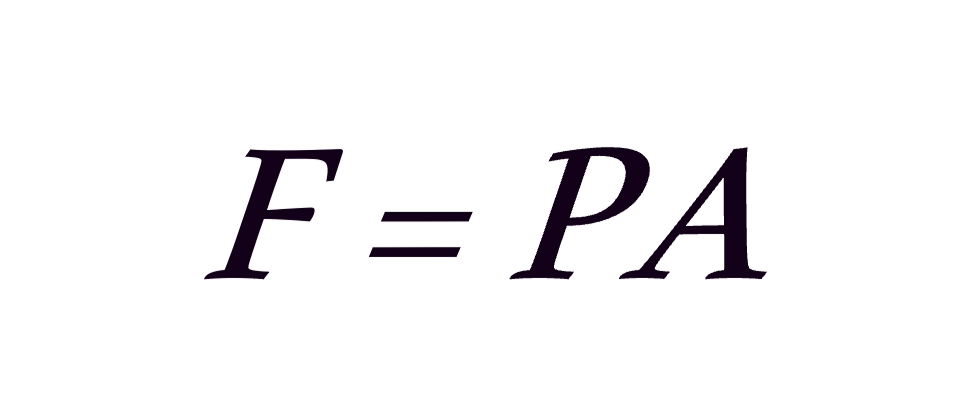 Gas springs consist of a precision rod attached to a piston, moving within a sealed cylinder containing pressurized nitrogen gas and oil. Their force (F) is equal to the pressure differential (P) between internal and external (environment) pressures, acting on the cross-sectional area of the rod (A).
While for most applications ∆P (pressure differential) can be approximated by the spring’s internal pressure (P), ∆P must be taken in consideration for gas springs used in high pressure environments (e.g. Sub-sea applications).
How does it work?
As the piston rod is introduced into the cylinder (compression stroke), the internal gas volume decreases resulting in a proportional increase in pressure (Boyle’s Law). Consequently, the force of a gas spring is higher when the rod is compressed (see Figure 1).
The difference between the forces seen at the two extreme rod positions- named P1-force and P2-force respectively- is an important gas spring characteristic and called K-factor (IGS) or gas spring progression. When compared to mechanical springs, gas springs can achieve very low K-Factors, typically ranging from 1.05 to 1.8 (or 5% to 80% progression). Unlike coil springs, gas springs are pre-loaded (pressurized) at the required P1-force which is available immediately.
For this reason, P1 force must be taken in account when calculating the force of a gas spring at a given position:
Where F is the force of a gas spring, k is the spring constant expressed in N/mm (force change per unit of compression) and X is the deflection distance in mm.
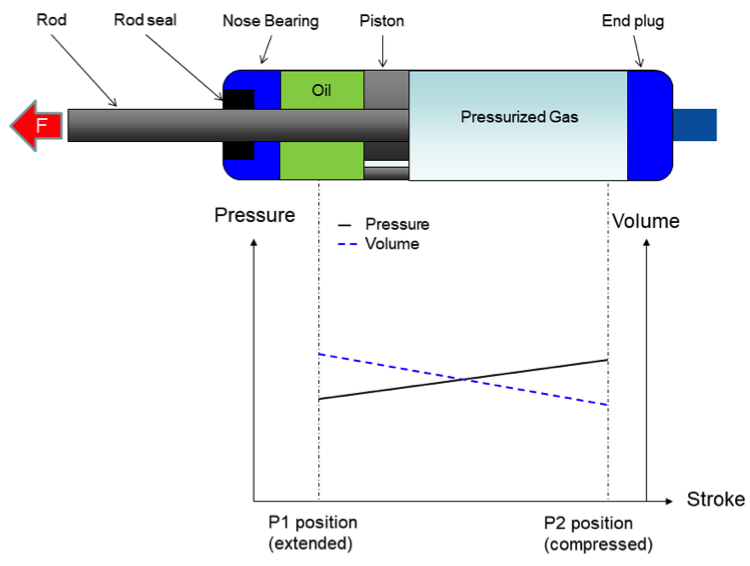
Figure 1- Gas Spring schematic - Pressure/ Volume vs. stroke diagram. As the piston moves from the fully extended position (P1) to the fully compressed position (P2), the pressure (solid line) rises and the volume (dashed line) reduces.